Category Archives: General Advice

Survival Rates Have Increase For Premature Babies

This week there’s been research published in the British Medical Journalthat has the feel of genuine ground-breaking stuff.

What it shows is that doctors are getting better at saving the lives of premature babies, but are making little difference when it comes to preventing serious long-term disabilities in this group of babies.

The research was done by teams from University College London and Queen Mary, University of London.

They got reports on every baby born before 27 weeks in 2006 in England. They compared these babies with those born in 1995, who they had previously studied.

The good news was that more of the pre-term babies survived.

In 1995, 40 per cent of the babies survived – a decade later the number had risen to 53 per cent.

Interestingly, there was no increase in survival for babies born at 24 weeks.

But babies born before 27 weeks face a battle for survival and many go on to live with long-term health problems such as lung conditions, learning difficulties and cerebral palsy

And when the researchers looked at how many babies had these problems, there was hardly any difference between the 1995 group an the 2006 group – about 18 per cent suffered disability.

More babies now survive being born too soon than ever before, which is testament to the highly-skilled and dedicated staff in our neonatal services.

But as the number of children that survive pre-term birth continues to rise, so will the number who experience disability throughout their lives.
3D Acryllic Models of Foetus To Be Produce for New Mums

Expectant parents in Japan who can’t wait to show the world what their baby will look like can now buy a three-dimensional model of the foetus to pass around their friends.

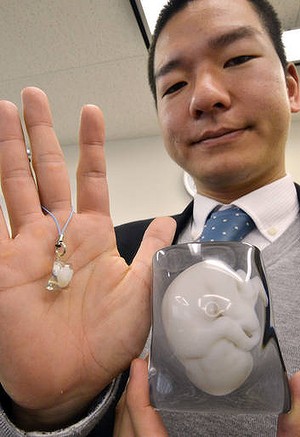
The nine-centimetre resin model of the white foetus, encased in a transparent block in the shape of the mother’s body, is fashioned by a 3D printer after an MRI scan.

“As it is only once in a lifetime that you are pregnant with that child, we received requests for these kind of models from pregnant women who… do not want to forget the feelings and experience of that time,” said Tomohiro Kinoshita of FASOTEC, the company offering the service.

The “Shape of an Angel”, which costs 100,000 yen ($1164), comes with a miniature version that could be a nice adornment to a mobile phone, he added. Many young women in Japan have decorations attached to their mobile phone strap

The company said the ideal time for a scan is around eight or nine months into the pregnancy.

For those who would like a less pricey version, the company will start offering a 3D model of the face of the foetus at 50,000 yen ($582) in December.

It will use ultrasound images taken at a medical clinic in Tokyo that has forged a tie-up with the company.

FASOTEC, originally a supplier of devices including 3D printers, uses a layering technique to build up three-dimensional structures. The technique has been touted as a solution to localised manufacture on a small scale.

The company also produces 3D models of internal organs that can be used by doctors to plan surgery or by medical students for training, a spokesman said.

It is also possible that models can be used in hospitals to better inform patients what their problems are, instead of relying on difficult-to-understand diagrams.

The technology “realises not only the form but also texture of the model – for example making it hard or soft”, the firm said in a statement.

“By making a model that is similar to a real organ or bone, one can simulate operations and practise different surgical techniques.”

Kinoshita said the company hit upon the idea of making 3D models of unborn babies in the hope that people would become more aware of the technology.

The company said some medics could also foresee diagnostic possibilities with the models that may help predict difficulties in the birthing process.

Three-dimensional printers have been around for several decades but advances in the technology mean it is now gaining in popularity in several fields.

The machines work in a similar way to an inkjet printer, but instead of ink they deposit layers of material on top of each other, gradually building up the product they are making.

Where traditional manufacturing only becomes efficient with economies of scale because of the need to produce moulds, 3D printing is capable of producing single copies of relatively complicated objects.

The technology is not yet advanced enough to build telephones or computers but it is already used to make components.


Top 10 Baby Names of 2012

Congratulations to the Aiden’s and Sophia’s around the world – they’ve topped the list of popular baby names once again.

Nipping at Aiden’s heels is Ethan, who surged up the boys’ list four spots since last year to land at number 3. Jack broke into the top 10, joining Jackson, Jacob, and Jayden, and making J the most popular starting letter for boys’ names.

Mia climbed into the girls’ top 10 list this year, striking a pose at number 9.

Top 10 Girls’ Names of 2012

  1. Sophia
  2. Emma
  3. Olivia
  4. Isabella
  5. Ava
  6. Lily
  7. Zoe
  8. Chloe
  9. Mia
  10. Madison

Top 10 Boys Names of 2012

  1. Aiden
  2. Jackson
  3. Ethan
  4. Liam
  5. Mason
  6. Noah
  7. Lucas
  8. Jacob
  9. Jayden
  10. Jack


The 12/12/12 Baby.

Baby Oliver becomes one of the last babies to be born on a special date for this century. Oliver was born at 12:12pm on the 12th day of the 12th month, 2012.

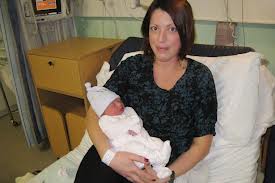
Oliver Talmage arrived today at the Princess Alexandra Hospital in Harlow, Essex, six hours after mum Hannah MacLennan went into labour.

Proud Hannah said today: “As soon as he was born the midwife came in and pointed out the timing.

“We were already celebrating and this makes it all the more special. He was due on the 18th so it’s come as a bit of a surprise.”

Hannah, an admin worker at an investment bank, and her husband, Andrew Talmage, 39, who works in car restoration, already have one son, three-year-old Jack.

They are expecting to return to their home in High Ongar, Essex, with 7lb Oliver later today.

Hannah said: “We’ve told the rest of the family the news and everybody is really happy.”

Andrew added: “We’re just delighted to have a healthy baby – anything else is just a nice extra.”

The historic six-figure alignment of dates and times is the last time such a moment will occur this century.

A Born Survivor.

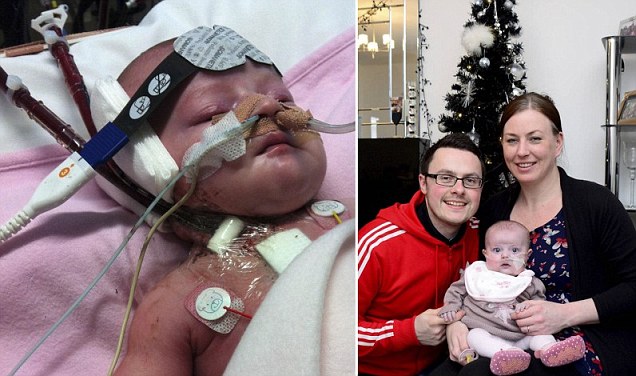
Baby girl  Jessica, who underwent open heart surgery at just 30 minutes old, has been allowed home to celebrate her first Christmas.

Five-month-old Jessica Muse is believed to be the youngest person ever to undergo open heart surgery after she had the procedure half an hour after birth.

Jessica has spent her whole life in hospital, but yesterday she left the Freeman Hospital in Newcastle for the first time with her delighted parents Claire and Dom, so they can enjoy the festive season at home.

Jessica was born with hypoplastic left-heart syndrome, meaning she essentially had half a heart – as the left side was severely underdeveloped and did not work.

The life-threatening condition was detected during Claire’s 20-week scan and doctors also discovered she had an ‘intact septum’ meaning the top two chambers of her heart were fully closed.

Without surgery, Jessica would not survive after birth.

When she was born weighing 7lbs 5oz on July 16 this year, Claire, 31, and husband Dom, 29, a process operator at a factory, only managed a quick glimpse of their daughter before she was whisked away for surgery.

Dr Asif Hasan performed the delicate operation on Jessica, whose heart was the size of a walnut, in an open heart procedure known as an atrial septostomy.

The top two chambers of her tiny heart were cut open and the op helped her survive long enough to have another seven-hour long open heart procedure at ten days old.

At one point, her parents, of West Allotment, Newcastle, were told their daughter’s chances of survival were ‘very small’ and feared she might not make it.

But after nine operations in total, including the two open heart surgeries, Jessica is battling back and is getting used to life at home.